
My Time Management Lesson from Sharjah Masters

As you might know, I wrote an article on how to deal with time pressure in chess. What I didn’t cover in that article came back to haunt me in the recently concluded Sharjah Masters 2025.

The problem I’m referring to is playing impulsively — moving too fast at critical moments. There’s a difference between playing fast and playing too fast. Playing fast is fine as long as you’re emotionally in control and consciously processing the position. This particular problem affects not only players who play too fast, but also those who frequently find themselves in time trouble. At some point in the game, we all tend to make moves a bit too quickly.

Even a non-chess player can understand the drawback of moving too quickly: you’re more likely to make a mistake because you haven’t fully evaluated the position.

What I want to talk about in this article is a common habit among chess players — responding instantly as soon as the opponent makes a move. There are different reasons we fall into this pattern:

  • To show confidence or assert dominance
  • To gain time on the clock
  • To reach the next time control faster
  • Believing it’s an obvious or automatic move

In this article, I’ll share some impulsive mistakes I made during a recent game, along with the thought process behind each move.

The game was played as black against Grandmaster Visakh NR, who was rated 2507 before the game. I’ll also highlight a couple of critical moments leading up to these impulsive decisions.
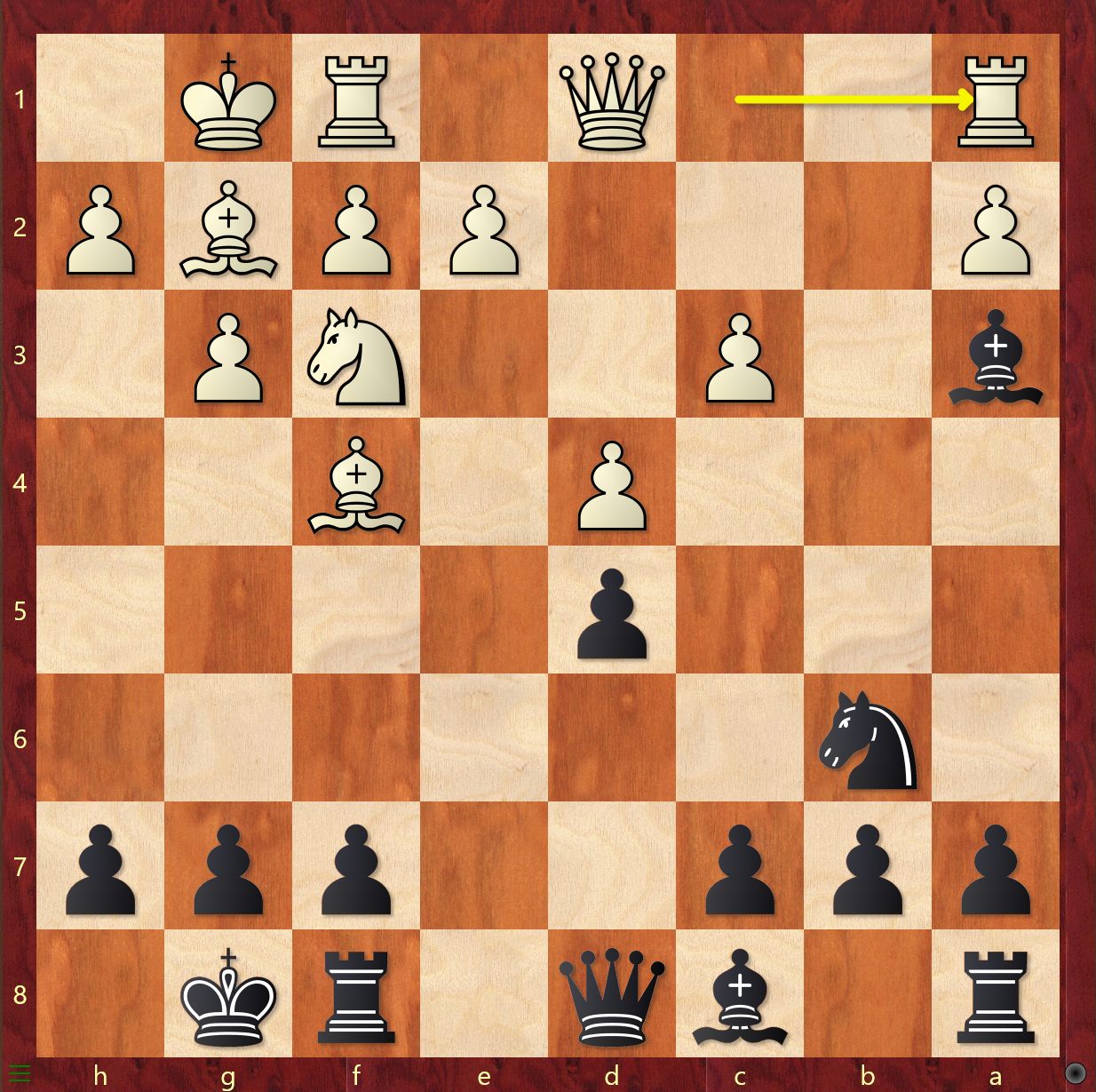
Let’s directly jump in after white’s 12th move. I missed my opponent’s 12.Ra1! move. Now 12….Bb2 is not great because of 13. Rb1 Bxc3 14. Rc1 and the c7 pawn falls. For some reason, I assumed Rb1 was forced, and I was planning to play Bf5 with a gain of tempo. This was the first critical position. Where do you think Black’s light-squared bishop belongs? White is also preparing to play Qb3 next—so what would you do about it?

I played 12…Bf5, probably the most logical move in the position. Then came 13.Qb3 Bd6 14.Bxd6 Qxd6 15.Nd2, and it finally became clear to me that White was pushing for an advantage. I realized I had made a slight inaccuracy. White is preparing to play e4 next, which seems to give him a symbolic edge. Moves like Ne4, Nc5, and so on are coming.

Let’s go back to the position after 12.Ra1. Here’s what I learned after analysing with the computer

  1. It’s better for black not to exchange the dark squared bishops. The reason being that once the dark squared bishops are exchanged, it’s easier for white to penetrate with e4 dxe4 Nxe4 and then Nc5. If black keeps the dark squared bishop then Nc5 is not a threat. Also d6 square will be controlled.
  2. Bishop on f5 is not very well placed if white is preparing to play e4. When playing 12…Bf5 I assumed that I should be able to stop e4 somehow but I don’t think it’s really possible. Then what’s the ideal square for light squared bishop? Suprisingly, it’s e6! The point is to prepare e4 break with dxe4 and then put the bishop on d5 to counter the g2 bishop! Once the center opens up with the bishop f5, the g2 bishop will become a pain.
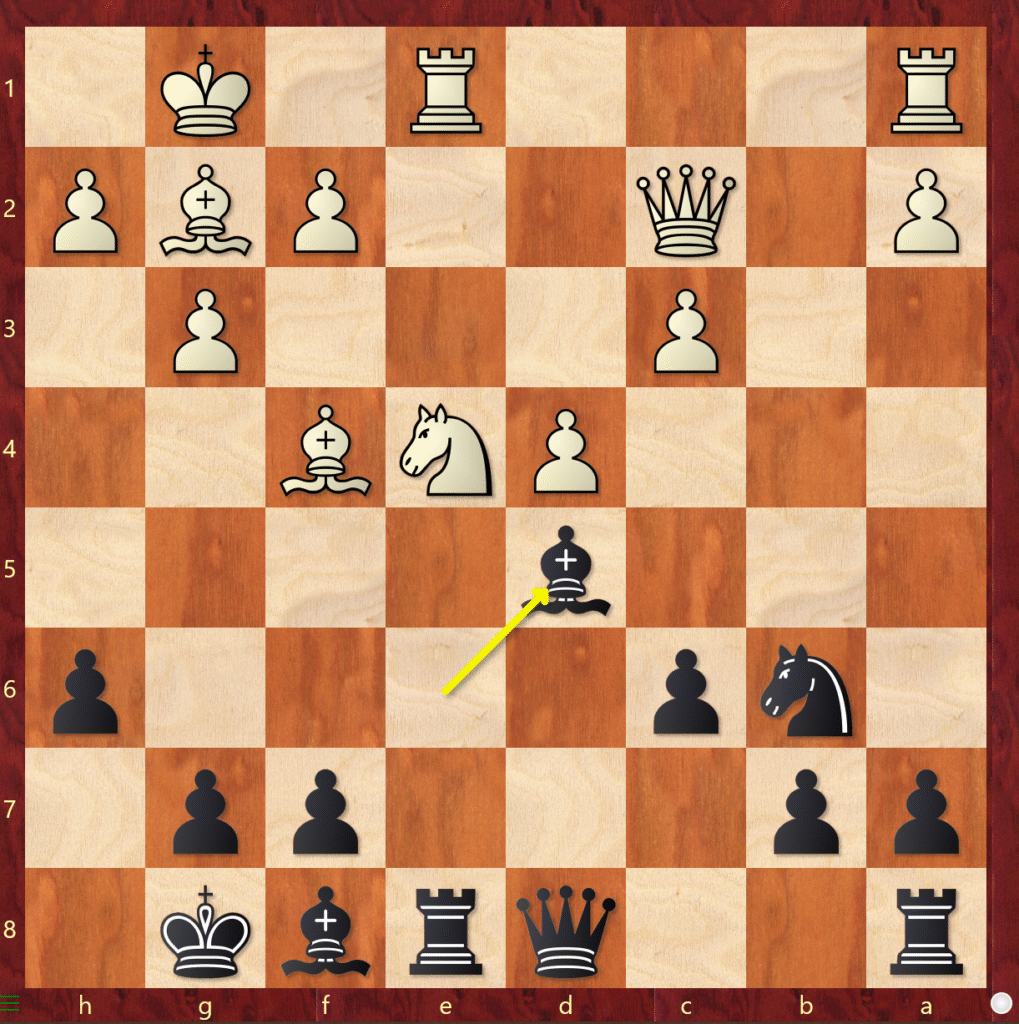
Something like this would be a dream for Black! The bishop on d5 suppresses the g2 bishop, and it’s also worth noting that the dark-squared bishop keeps an eye on both the d6 and c5 squares.

Anyway, let’s move on. In the game, the following moves occurred: 12…Bf5 13.Qb3 Bd6 14.Bd6 Qd6 15.Nd2 Rfe8 16.Rfe1.

After a long think here, I realized that the bishop belonged on e6. So I played 16…Be6!? 17.e4!? dxe4 18.Ne4 Qd8 19.Qb5.
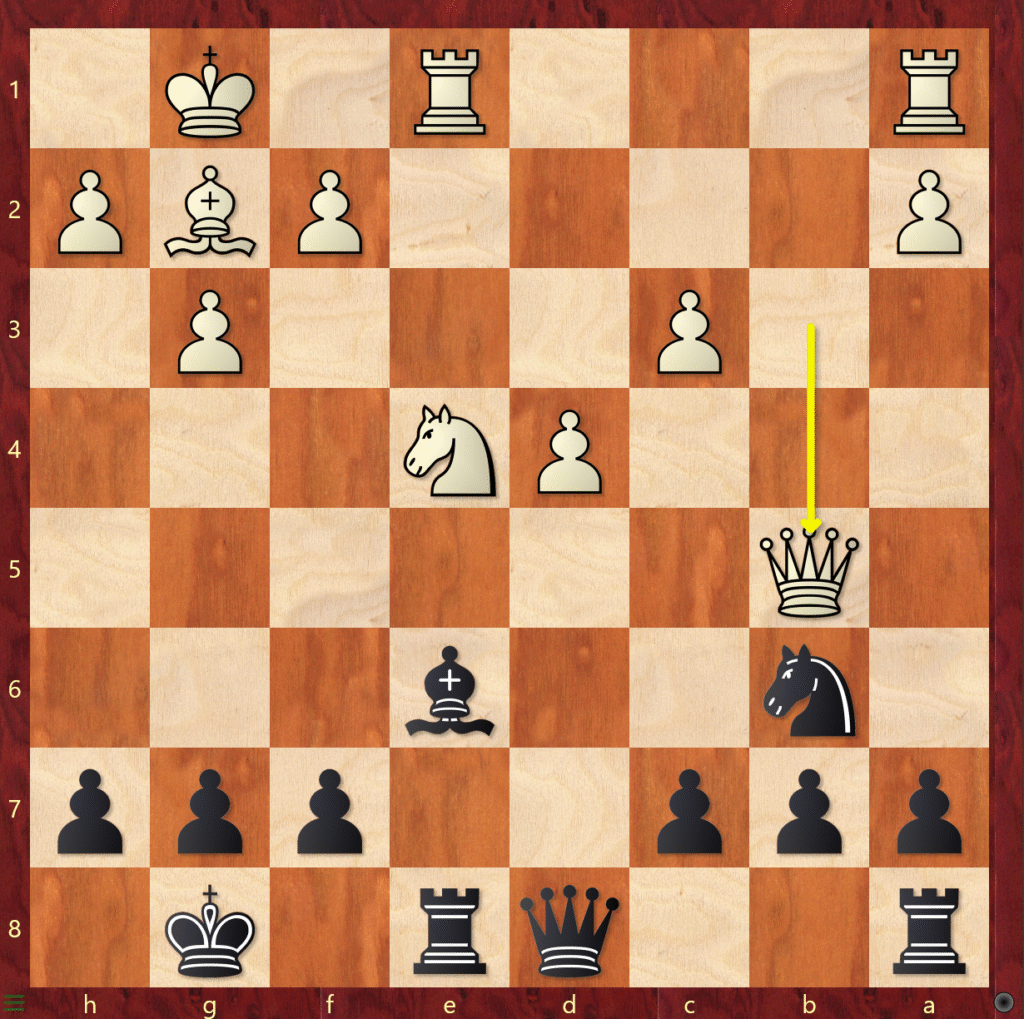
This was a semi-critical point. White had a very small positional initiative — he was planning to play Nc5, possibly a4 in some lines, and so on.

I wanted to play 19…Bd5 here and calculated this line a bit: 20.Nc5 Bg2 21.Kg2 Qd5 22.Kg1 Re1 23.Re1. I thought this should be within drawing range, but it still looked like something for White. A part of me didn’t want to liquidate the position and have to suffer for a draw — and another part of me did. These kinds of situations are psychologically tricky, especially when you’re not exactly sure what you’re fighting for.

Then I noticed I could play 19…c6!? If 20.Qg5, then I thought Qxg5 21.Qxg5 Bd5 was accurate, and I’d be completely fine. I briefly looked at 20.Qc5 and my thought process was: I can even go 20…Bd5 21.Nd6 Re1 22.Re1 Qd7, and I felt this should be okay since I’m going to exchange the light-squared bishops and simplify.

My opponent thought for a bit and played 20.Qc5 — and without much thought, I played out the whole line I had just described, like an idiot.
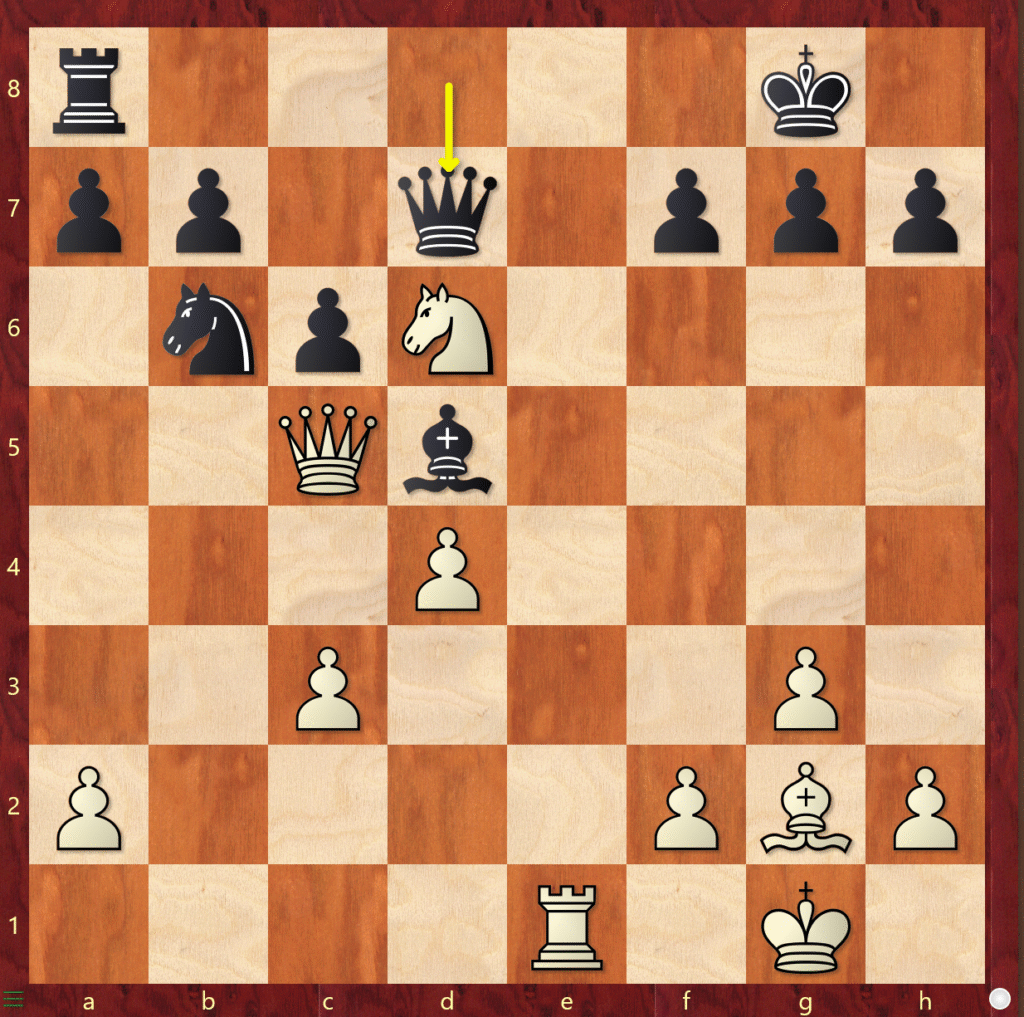
What did I miss here?

23.c4! — a simple move, after which I’m close to being busted. Honestly, I think it’s an easy move to spot. So why did I miss it? Because I didn’t think at all. I just played all my moves quickly after Qc5.

I even managed to make the position worse over the next few moves, and the following position arose.
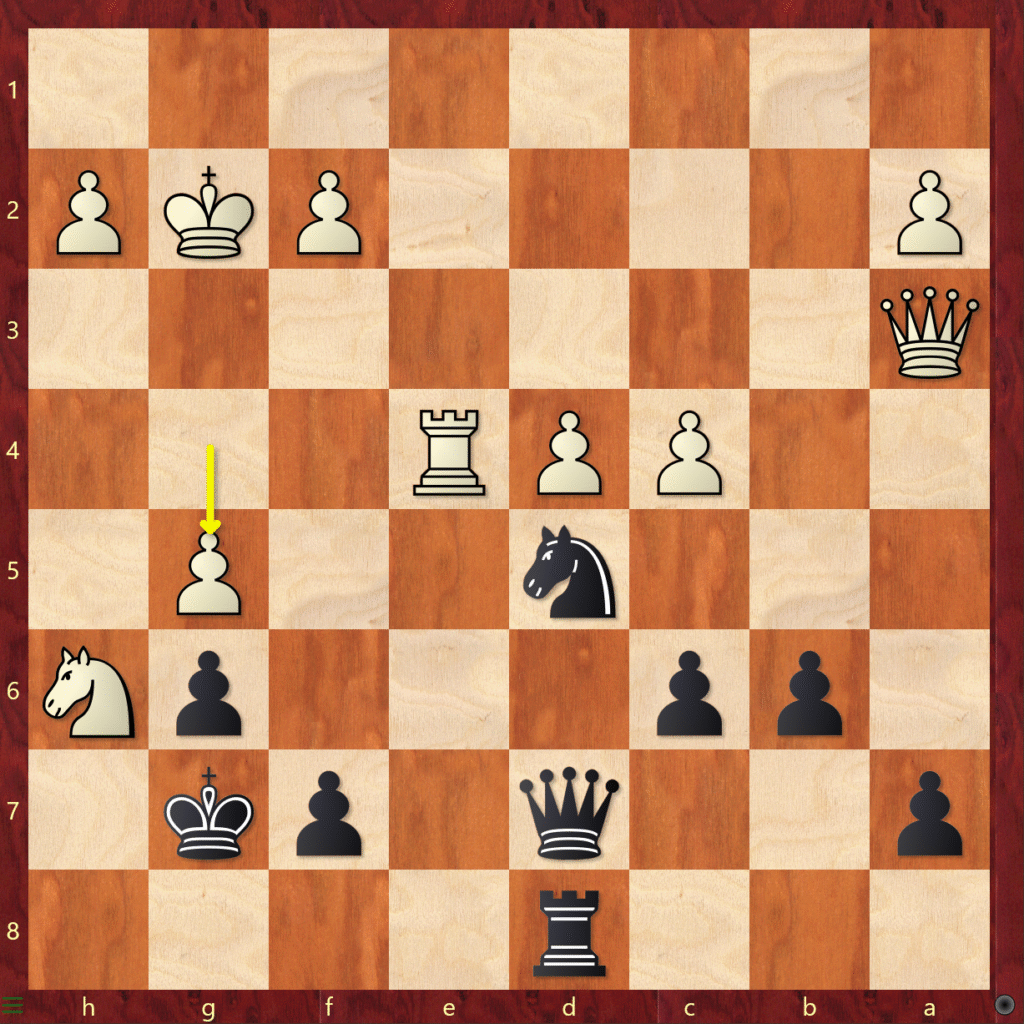
This is the position after 30.g5. White is clearly winning here, but I started to play well again. What is Black’s best try in this position?

30…Re8! — the idea being that if 31.Rxe8, then 31…Nf4, and 32.Kf3 is not possible due to 32…Qh3!.

White is still winning here — see if you can find how.

My opponent played 31.Rh4, which initially looked like the most critical try to me.
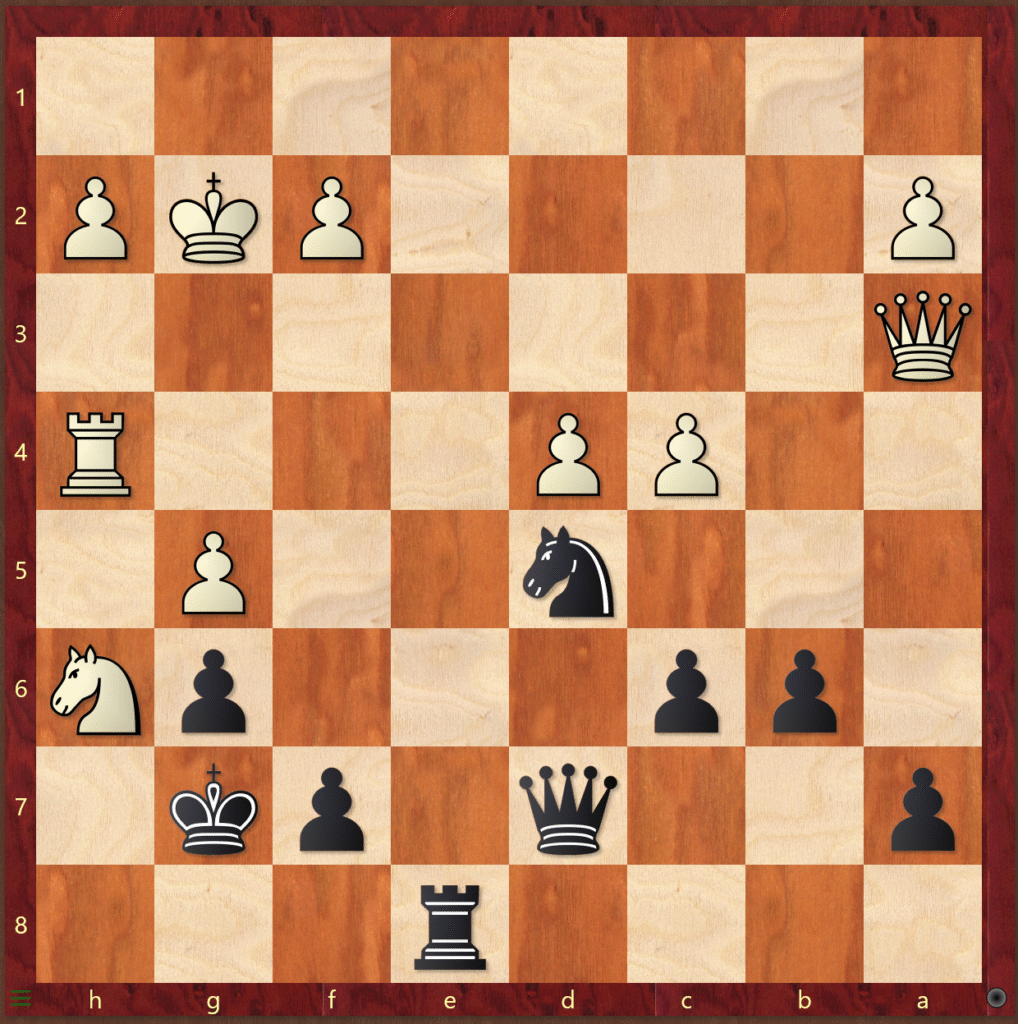
How should Black defend here? The next two moves I played — without any false modesty — were worthy of the best player in the world.

The correct move here is 31…f6! — the only move. The idea is that if 32.cxd5 fxg5! (32…Qd5 33.Kg3 followed by Ng4 wins for White), then 33.Rh3 Qd5. If 34.Qf3 Qxf3 35.Kxf3 Rh8, Black wins back the material. Even 34.f3 Re2 also seems quite okay for Black.

My opponent responded with 32.Qg3, which again is the most critical move in the position.
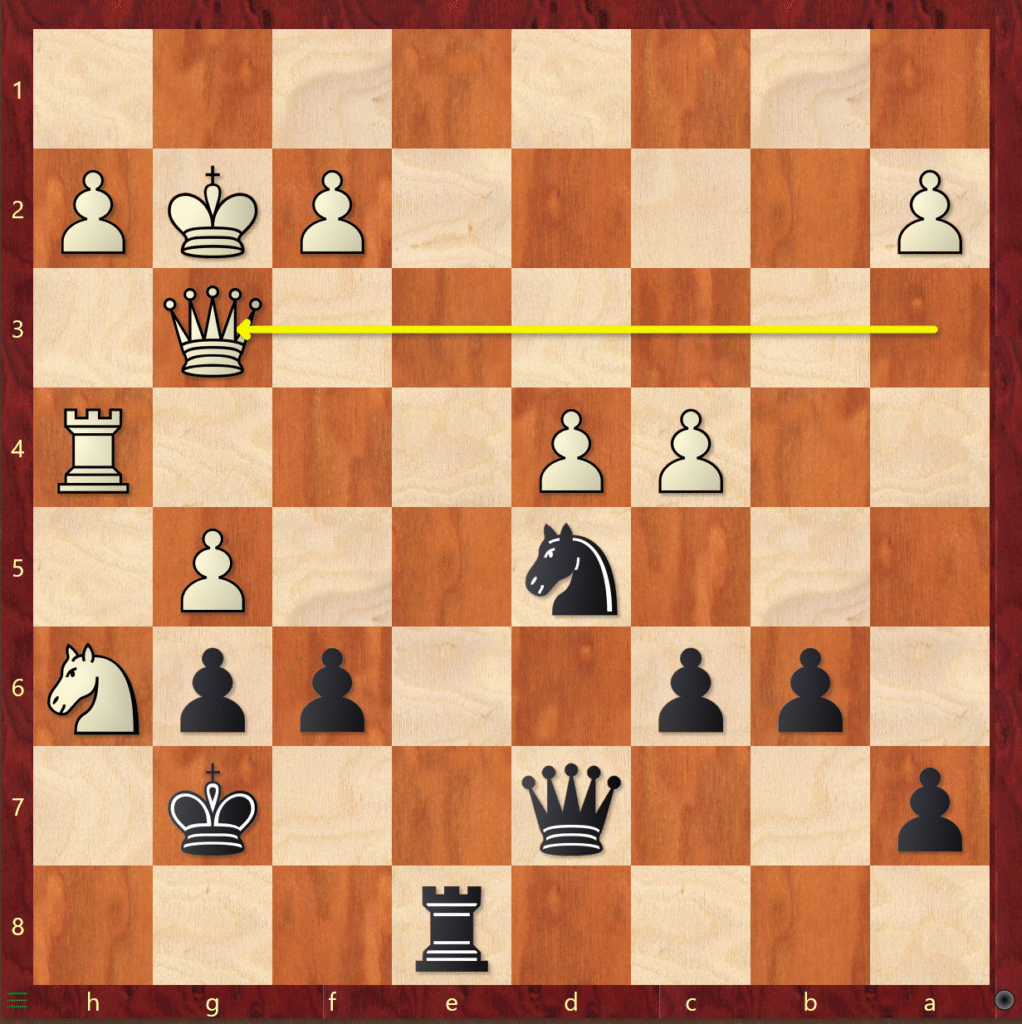
What would you play here as Black? Can you find the only move?

I played 32…b5!! — forcing White to make a decision about the c4 pawn. Here, I calculated a variation accurately to make it work: 33.cxd5 Qd5 34.Kh3. I considered this to be the critical line. Then 34…fxg5 35.Qc7+ Kf8 (it’s not mate, luckily), 36.Rg4 Re7!! — and I was proud of myself for seeing this.

The key point is that after 37.Qg3, there’s Rh7, and if 37.Qb8, then Kg7 — and Black is doing fine.

This was the main variation I was calculating while my opponent was thinking. I also briefly considered 33.gxf6 Nxf6 34.Ng4. I didn’t calculate it deeply, but I felt I could play 34…Ne4. If 35.Qh3, then Ng5!? stops Rh7. If 35.Qf4, then g5 — I thought — and I couldn’t believe it was actually working.

I was excited and went back to analyzing the other critical variation while my opponent was still thinking.

What happened next? My opponent played 33.gxf6 Nxf6 34.Ng4.
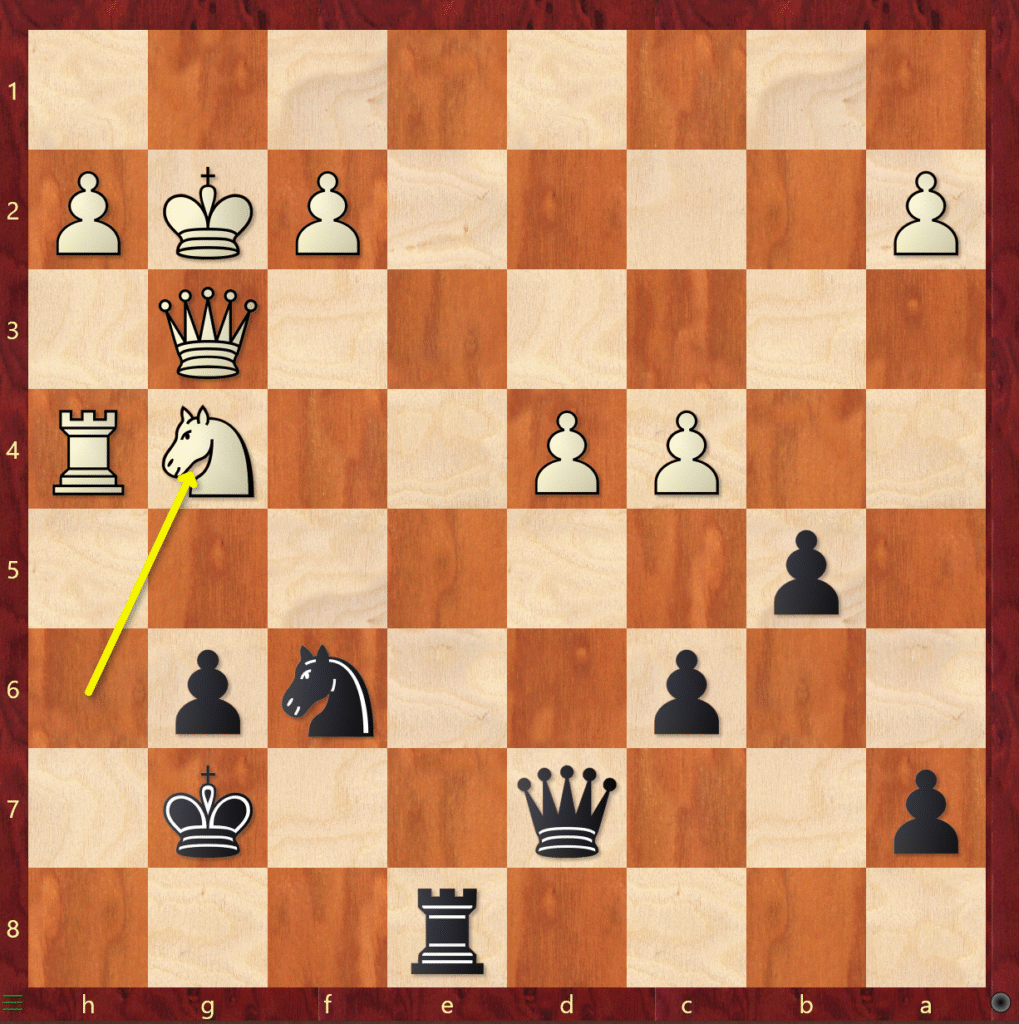
What do you think Black should play here? And what do you think I actually played?

Without a second thought, I played 34…Ne4. It loses rather easily after 35.Qe3. If g5 now, then 36.Ne5 follows. Funnily enough, 34…Ne4 35.Qh3 Ng5 is also a blunder because of Qc3 — and it loses too.

I still can’t understand how I could play moves like f6 and b5 in the previous two moves, and then suddenly play something like Ne4?! The equality was straightforward.

34…Nxg4 35.Rg4 Re6 is solid. The computer also likes 34…Qd4 35.Qc7 Nd4, though I’m not sure how practical that is over the board.

The main takeaway — for me and for you, if you’ve made it this far — is that playing too fast can be just as damaging as playing too slowly.

The reason I played 34…Ne4 so quickly was partly excitement and partly a desire to put pressure on my opponent, as we were nearing potential time trouble.

What frustrates me the most is this: even if I had spent just 10 seconds thinking about what White could do, I would have realized that my move was nonsense.

Here’s what I would do next time:

  • I’ll avoid making impulsive moves or playing at blitz speed whenever it’s not necessary.
  • If I still find myself tempted, I’ll force myself to spend an extra 30 seconds to a minute to check for flaws in my line.
  • I’ll also take the time to consciously identify candidate moves, rather than locking in on one too quickly

Unfortunately, this was not the first time I have committed this mistake. Good or bad, I have a feeling I might end up repeating the same mistake. But recognizing it is the first step toward improvement. Chess is a constant learning process, and even our worst errors can teach us valuable lessons if we’re willing to reflect and adapt.

I hope sharing my experience helps you avoid similar pitfalls in your own games. Remember, patience and mindful thinking often make all the difference.

Useful links

The Game

How to deal with time pressure

Final Thoughts

Please excuse any inconsistencies in the chessboard sizes or formatting—I’m still learning the ins and outs of website design! My main focus is sharing my journey in chess improvement and the lessons I’ve learned along the way.

I’d love to hear your thoughts and feedback on this article. Whether it’s about the content, the analysis, or even the presentation, your input will help me grow as a player and a writer. Feel free to reach out to me directly at karthik@chess-cult.com

Thank you for reading, and here’s to improving together!

Jocko Willink’s 5 Wake-Up Calls for a Better Day

Jocko Willink is more than a Navy SEAL — he’s pure discipline. These 5 wake-up calls will snap you out of excuses and into action.


1. Binary Code: The End of Overthinking

Overthinking drains your time. It drains your energy. So stop debating and start deciding.

Reduce every decision to a simple binary: Yes or No.

Are you going to wake up early? Yes or No.
Are you going to study that endgame? Yes or No.
Are you going to fix your mindset? Yes or No.

That’s it. Don’t spiral. Don’t delay. Ask. Answer. Act.

You don’t need more motivation.
You need clarity.

That’s what Binary Code gives you.


2. GOOD: Turning Setbacks into Strength

What does Jocko say when things fall apart? Good.

Not because it feels good — but because every obstacle is an opportunity if you choose to see it that way.

Blundered a winning position under time pressure? Good. Now you know it’s time to improve your time management.
Played a terrible tournament? Good. That’s fuel for the next one.

Good is not fake positivity. It’s a disciplined mental shift.

You don’t dwell on what went wrong. You reframe. You redirect. You rebuild.

Every loss contains a lesson — if you meet it with the right mindset.


3. Not Feeling It

Michael Phelps trained every single day for six years before the Olympics.

No days off.
Birthdays. Holidays. Sick days. He showed up anyway.

Do you think he felt like training every day?

Of course not. But feelings didn’t matter. The mission did.

Don’t feel like doing calculation? Do it anyway.
Don’t like memorizing openings? Memorize them.
Not in the mood to prep? Prep harder.

Discipline doesn’t ask how you feel.

You don’t rise to the level of your feelings. You rise to the level of your discipline.


4. Questions

We all start with limited knowledge.

But growth comes from one habit: ask questions relentlessly.

When you don’t understand a position — don’t skip it. Study it. Break it down.

Why is this position better for White?
Is it because of the dynamic piece activity or a structural imbalance?

Don’t just accept the engine’s evaluation — question it.
Try to understand why it prefers one side. What principles are at play? What long-term plans does it see?

This isn’t just chess advice — it’s a life rule.

Have no shame in not knowing. The only shame is in staying that way.


5. The Count Is Zero

In Navy SEAL training, there’s a brutal drill: Log PT.

Recruits do push-ups, squats, lunges — all while holding a massive log overhead.
Say the goal is 100 pushups. One guy collapses at 56?

Count is zero. Start over.

That same principle applies to chess. And life.

You can play 35 perfect moves…
But if move 36 is a blunder?

It’s over.

Count zero is harsh.
But it builds something rare: accountability.

Either you meet the standard — or you start again.


Want More?

If these ideas hit home, dig into Jocko Willink’s book: Discipline Equals Freedom.

It’s not a typical self-help book.
It’s a battle manual — for the war between you and your excuses.

Short chapters. No fluff. All mindset, grit, and action.

Highly recommended if you’re ready to level up your habits, discipline, and response to discomfort.

Useful Links

Want to read more?


Unlocking Growth: How to Get Better at Chess

Everyone wants to improve at something. This desire has no ceiling. It’s true that, at times, the urge to boost our rating or win tournaments overshadows the pure intention to improve — but deep down, no one can honestly say they don’t want to get better.

So, if the goal is clear — to improve — why doesn’t everyone do it?

The answer is a little more complicated. While qualities like discipline, consistency, persistence, and hard work are all important, we often lack clarity on how to improve. If we understood the process better, we could try to replicate it — but most of us don’t.

Two Key Problems Block Progress:

  1. We don’t know what exactly to do in order to improve.
  2. We know what to do, but don’t do it — usually because it’s hard.

This article will focus on the first problem: understanding what improvement looks like and how to pursue it effectively.

You might be wondering, “If you know all this, why aren’t you a World Champion already?”
Fair question. My problem lies more with the second issue — doing what’s required. But that’s for another day.


Three Areas That Affect Improvement

Let’s divide improvement into three broad areas:

1. Technical/Chess Skills

This may not be the most important factor, but without technical skill, the rest doesn’t matter. You can have the best mindset, but if your moves are weak, you won’t get far.

2. Mental Strength

Many players I know have solid skills but underperform due to mental blocks — pressure, confidence issues, tilt, etc.

3. External Factors

Your commitments, lifestyle, family environment — all of these affect how well you can focus and train. Favorable conditions can enhance performance, while unfavorable ones can hold you back.

For now, I’ll focus solely on the technical aspect.


Breaking the Myth: Repetition Alone Doesn’t Lead to Mastery

A common belief is that doing the same activity repeatedly over a long period will make you an expert. But that’s not always true. The key lies in the details of how you practice.

Example 1: Sam the Commuter

Imagine Sam, who drives to work every day and has done so for 20 years. Given this, would you expect him to compete in an F1 race?

Probably not. He’s been driving, yes — but he’s never trained in the way a racer does. His driving wasn’t designed to improve speed, control under pressure, or advanced maneuvers. It was routine.

Lesson: Simply repeating an activity — without challenge or intent — does not guarantee improvement.

Example 2: The Chess Beginner

Let’s say you just started chess and want to reach a 1600 rating. Your coach gives you mate-in-one puzzles, and over time, you become lightning fast — solving them in 5 seconds. You do this for 6 months.

Will that alone take you to 1600?

Definitely not. At first, those puzzles were appropriate. But once they became too easy, continuing with them was no longer useful. What you needed was a transition to harder material — mate-in-two, mate-in-three, and tactical patterns.

Lesson: Improvement requires constantly adjusting the level of difficulty to push your current limits.


The Power of Deliberate Practice

I first encountered the concept of Deliberate Practice in the book Peak by Anders Ericsson and Robert Pool . The authors studied world-class performers and asked: Were they naturally gifted, or was it their training that set them apart?

Their conclusion: Talent matters far less than people think. What really makes a difference is how someone practices.

What Is Deliberate Practice?

When you start any skill, your progress is fast at first. But soon you hit a plateau. At that point, continuing with the same routine stops producing results. Deliberate practice is a way to break through that plateau.

It involves:

  • Working with specific goals in mind
  • Isolating weaknesses
  • Receiving feedback
  • Pushing slightly beyond your comfort zone

Almost every elite performer began with passion. But at some point, they had to work in a structured and focused way to get better.


What About the 10,000-Hour Rule?

Malcolm Gladwell popularized the idea in Outliers that it takes 10,000 hours to master a skill. While catchy, this number is a generalization.

Peak clarifies that how you spend those hours is far more important than the number itself. If you spend 10,000 hours practicing the wrong way — without challenge, feedback, or adjustment — you won’t become an expert.


Applying This to Chess Training

Your training should reflect a few key principles:

  • It should be challenging, pushing you just outside your comfort zone.
  • It should be structured — targeting both your strengths and weaknesses.
  • It shouldn’t be so hard that it becomes demotivating, nor so easy that it becomes automatic.

Working on Strengths and Weaknesses

Improvement can happen by working on either — or both — your strengths and weaknesses. What matters is that the process challenges you and pushes your capacity.

There are two major schools of thought on whether it’s better to double down on your strengths or fix your weaknesses — something I’ll explore in a future article. For now, just know that both approaches can work as long as your training is intentional and effortful.

How Can Training Be Challenging?

There are two main ways people introduce challenge into training:

1. Difficulty-Based Challenge

This is when the material itself becomes more complex.
Some examples:

  • Selecting a tougher chess book
  • Trying to solve puzzles blindfolded
  • Analyzing grandmaster games without engine assistance

These are not strict recommendations — just examples to illustrate what increasing difficulty might look like.

2. Time-Based Challenge

This is where time pressure adds intensity.
Examples:

  • Beating your high score in a 3-minute Puzzle Rush
  • Solving as many exercises as you can from a book in a 1-hour window, then trying to improve on it later

Again, these are illustrations — not one-size-fits-all solutions.

Why Not Make Training Extremely Hard from the Start?

Imagine a 6th-grade student trying to learn from a 10th-grade physics textbook. It wouldn’t work — not because the book is bad, but because the foundation isn’t there yet.

The same thing happened to me. I once wanted to understand how the universe began, so I picked up Stephen Hawking’s The Theory of Everything. Just 10 pages in, I gave up — not due to a lack of interest, but because I had zero background knowledge. The concepts and terminology were completely unfamiliar.

Lesson: Learning must be progressive. If it’s too hard, you’ll burn out or lose motivation. The goal is to operate at the edge of your ability — not beyond it.


Key Takeaways

  1. Challenge is essential — You need to constantly push your boundaries to make progress.
  2. But not too much — If the training is overwhelming, it becomes counterproductive.
  3. Structure matters — Your training should be intentional and designed to target both strengths and weaknesses.
  4. Repetition isn’t enough — Mindless repetition leads to plateaus. Improvement requires deliberate, mindful practice.

Coming Up Next

I want to dive deeper into this in my next article — including more methods, tools, and principles to structure your chess improvement effectively.

If you’re interested in the books I mentioned, here are the links again (these are affiliate links — using them helps support this content at no extra cost to you):

Here are my other articles for you to read

What Really Separates Champions from the Rest

Have you ever caught yourself thinking, “If only I were younger, maybe I could’ve chased my dreams…”?

I never really bought into that idea — and I still don’t. Age doesn’t matter when it comes to passion and goals. Not in the way most people think.

Sure, if you’re aiming to be a world-class sprinter, your window might be tighter. But for chess? Your peak years are defined more by mindset and dedication than by youth.

So let’s dismantle one of the most persistent myths in chess: that the top players are born with something the rest of us lack.

This might be a semi-lazy article — not packed with stats or technical depth.But it gets the point across, and sometimes that’s all you need.

 The Myth of Natural Talent

We toss around the word “talent” far too casually. When someone performs brilliantly, we often say, “They’re just naturally gifted.” But what does that even mean?

Sometimes we mean they have an innate ability. Other times, we just mean they’re really good. But in either case, the word glosses over the real story behind excellence: work, obsession, focus, and love for the craft.

Let’s talk about three of the best examples in chess today: Magnus Carlsen, Rameshbabu Praggnanandhaa (Pragg), and Dommaraju Gukesh.

Obsession Over Giftedness: Pragg and Gukesh

Do I think Pragg or Gukesh are naturally gifted?

No — not in the way most people think. What they are is obsessed. Chess isn’t a game to them — it’s a part of their identity. They think about it constantly, study it deeply, and return to it even after setbacks.

They started young, yes. But what really set them apart was how addicted they became to the process. That’s what we call “talent,” when really it’s just hard work that looks effortless because they love it.

Can most people match that intensity? Probably not. I study chess regularly, but I’m not consumed by it in the way they are. That’s the difference — not genetics.

If you told Gukesh he’d win his next tournament by studying 8 hours a day for 30 days straight, I believe he’d do it without hesitation.

 Effortless Genius: The Magnus Carlsen Story

Magnus Carlsen seems like an exception, right? He picks up ideas quickly, dominates in rapid formats, and makes it all look easy.

For a long time, I assumed he was simply naturally gifted. But over time, I realized that wasn’t the full story. In a podcast with Joe Rogan, Magnus casually mentioned that even while they were talking, part of his mind was still thinking about a game he had played earlier that day. He also said something similar during an interview in London — and that level of mental engagement stuck with me.

He’s not sitting at a board for 8 hours grinding out positions. He’s not the type to study like that. But his relationship with chess is constant. He reads chess books — even basic ones — and says he finds value in all of them. He watches games, plays bullet and blitz online, and consumes chess in every way imaginable.

He’s always thinking about chess. Not because he’s forcing himself to — but because he’s wired to engage with it. That obsession, not some mythical talent, is what built his understanding of the game.

 The Real Gift: Focus, Discipline, Resilience

Are Pragg, Gukesh, and Magnus gifted?

Yes — but not in some mystical, unachievable way.
They’re gifted in their discipline, their focus, and their resilience. At an age when most kids are distracted by everything around them, they locked in. When they lost games, they studied harder. When they hit walls, they kept going.

That’s not a talent. That’s a choice repeated thousands of times.

And that choice is available to all of us.

Final Thoughts: It’s Not Too Late. It Never Was.

You don’t need to be five years younger. You don’t need to be born with a chess gene.

What you need is the right kind of obsession — one driven by love for the game, not fear of failure. If you can build the discipline to study, reflect, and keep showing up, you can reach your goals.

Maybe not world #1 — but far beyond where you are now.

In upcoming articles, I’ll explore how anyone — whether you’re 18, 40, or even 60+ — can make meaningful progress in chess. I’ll break down the core tools for improvement, and how you can apply them at any age, without needing so-called natural talent.

Because in the end, talent isn’t the difference-maker. Obsession is. And obsession — the deep, consistent desire to get better — is something anyone can choose.

Relevant links

Joe Rogan podcast with Magnus Carlsen

London Eye Interview

Want more insights like this delivered straight to your inbox? Subscribe to my newsletter for practical chess tips, deep reflections, and strategies to level up your game — all in one thoughtful email.
👉 Click here to subscribe